« May 2009 | Main | July 2009 »
June 30, 2009
reforming civic education
[11/25/09: Please also see my statement on the Center's federal audit.]
In Tampa, meeting with social studies teachers) For quite a few years, almost all of the federal government's investments in civic education have been earmarked for the Center for Civic Education (CCE). In 2009, the Center's earmark from the US Department of Education was $31.9 million. CCE spent most of those funds on "We the People," a high school government curriculum, and "Project Citizen," a curriculum for middle school students who study policy issues of their choice and develop responses. CCE provides free texts and materials and offers training for teachers.
The available evaluations suggest that students in CCE's programs learn the material. We don't know some other interesting facts about these programs, such as how many students they serve, the students' demographic profile, or how much the programs cost per student. We cannot compare CCE's impact or its cost-effectiveness against alternatives. Still, in the absence of public data on those matters, I will stipulate that CCE probably benefits the kids who experience its programs.
However, it is not the role of the federal government to finance curricula or materials that serve a small number of American kids, year after year. The federal government generally doesn't select particular textbooks that seem beneficial and then provide them free of charge to limited numbers of schools where the teachers happen to request them. Nor should it provide programs like "We the People" or "Project Citizen" on those terms. Thirty-two million dollars is not nearly enough money to make a significant difference for the national student population, if it is spent that way.
Instead, a minimum of $32 million should be spent on innovation and growth. Competitive grants should be given to school districts, schools, other local government agencies, nonprofits, colleges, publishing companies, software developers, and other firms that propose to develop and test new approaches to civic education or to increase the scale or quality of their efforts. Thirty-two million dollars would be useful seed money, and over time it could benefit most American kids.
The Administration is asking Congress to end CCE's earmark. That seems like the right thing to do, but the next step must be to create a competitive alternative run by the United States Department of Education. Congress and the Administration should fund civic education--the original purpose of American schooling--at a minimum of $32 million for the whole country. Criteria for competitive grants should include: innovation, rigorous evaluation, a potential to grow and survive without further federal funding, and a focus on engaging disadvantaged kids.
Posted by peterlevine at 1:33 PM | Comments (2) | TrackBack
June 29, 2009
progressive reform requires trust in government
I'd be willing to bet that any climate change bill Congress passes this year will be an incremental improvement, but far from satisfactory. Likewise for health care. Not only will these bills have too little impact; they will also cost too much because corporate interests will have been bought off. Health and environmental reform could be accomplished more cheaply with more radical strategies, such as a single-payer health system and a straightforward carbon tax.
This situation is causing a lot of hand-wringing and calls for procedural reform, such as ending the Senate's filibuster rule. I think I'm for that, but I have a somewhat different view of how progressive change may unfold.
For me, the basic issue is that Americans deeply distrust the federal government. Back in the 1940s and 1950s, when the top tax rate was over 90% and each new Democratic administration took on bold new domestic challenges, most Americans said they generally trusted the federal government to do the right thing. That has not been true since the 1970s, when the tide turned in a conservative direction. Campaign and lobbying money do frustrate clean reform efforts, but it's also a big obstacle that Americans are fundamentally skeptical that the government can do a reasonable job. (This is the trend from American National Election Studies since they began in 1958:)
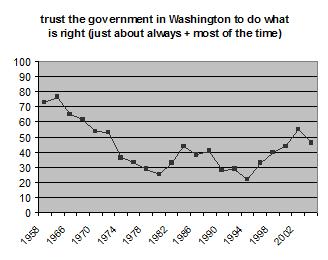
Some people (e.g., Thomas Frank, Paul Krugman) think that Americans distrust the government because of corporate and conservative propaganda. I tend to think, in contrast, that people know what their government is like from direct personal experience. Media coverage may be biased, but people aren't so easily fooled. On the basis of their own experience, they have formed a negative view of government.
This wasn't George W. Bush's doing; in fact, one of the biggest temporary increases in trust occurred during his first couple of years in office (mainly thanks to Osama bin Laden). Bush didn't deserve the trust he received from 2001-4, and Democrats were right to criticize his policies. But because Americans started with a very low baseline level of trust in the government as a whole, they didn't attribute all of its problems to Bush or to his party. As trust fell, so did fundamental confidence that the federal government could handle any essential challenges.
It is certainly true that Americans deeply distrust corporations today and are open to government regulation--in the abstract. But whenever the issue becomes an ambitious government-run alternative to corporate markets, Americans get nervous. That is the context for policymaking in the early Obama years. There are powerful crosswinds.
If Congress could somehow pass bold, efficient legislation that really worked, that might restore trust. I think progressive members of Congress should continue to press for strategies like single-payer and a carbon tax. Procedural reforms should be on the table, too. But I wouldn't depend on either of those approaches. Instead, I'd look for incremental steps that restore trust and that can build momentum. The more the Administration can involve Americans in both policymaking and actual public work, the better the chances for rebuilding trust.
Posted by peterlevine at 10:36 AM | Comments (0) | TrackBack
June 26, 2009
"Where is the knowledge we have lost in information?"
(Washington, DC for a presentation) The ease with which we can analyze social statistics today is remarkable. There are huge, free data-sets all over the Internet. You can employ exploratory statistical techniques (such as probit models or factor analysis) to fish for relationships. Even easier is to find a column of numbers on a web page, copy and paste them into an Excel document along with a different column of numbers from a different source, and find out whether they correlate. It can take five minutes to accomplish a task that would have taken thousands of person-hours when my Mom was a young health statistician. Many statistical investigations that would have been completely impossible--such as a multivariate model of a Census data-set with tens of thousands of cases--are now quite simple.
Graduate students, faculty, think-tankers, bureaucrats, and even some bloggers are busy at this work every day. But I don't think we understand society better than we did in 1960. At least, we don't understand it in ways that help us to make the world better. We are richer as a nation, so we should expect life to have improved. In some respects, it has. Relative to our assets, however, I think our performance is considerably worse. How could rates of high school failure, violent crime, cancer, unemployment, depression, suicide, and poverty be stubbornly flat if we had developed better solutions through social science?
To be sure, bad policy doesn't imply bad research; maybe there is a problem with implementation or with the motivations of the ruling classes. But figuring out how to address those obstacles should itself be a task for research. Besides, I am not overly impressed by the research-based proposals that are sitting around waiting for politicians and citizens to implement. At best, these ideas seem promising incremental steps, not game-changers.
What's wrong? It could be that ...
1) Correlational research provides limited understanding, because there are always unmeasured factors and influences. More powerful research is always experimental, and we don't do enough of that. By the way, "experimental research" is not just a matter of randomly selecting treatment and control groups. It also requires bold and exciting new projects or institutions that can be evaluated in that way.
2) We don't measure the important things. Test scores, yes; students' wisdom and virtue, no. Voter turnout, yes; emerging political networks, not so much.
3) Our imaginations are too limited by our tendency to take actual facts ("data") as necessary. Roberto Unger wants economics to be the scientific study of what might be possible. Instead, economics describes the present and recent past and infers from that description immutable laws. These laws may actually be subject to amendment, if we choose to change them.
4) Our attention is focused on the wrong levels or scales of analysis. Perhaps our scale is too modest. We ask whether interventions or programs affect outcomes, not which social philosophy is best. Or our perspective may be too broad and distant. We have tools for assessing whole populations, but few new techniques for understanding--let alone improving--specific neighborhoods, schools, or firms, let alone human beings. (There actually are techniques for those purposes, such as ethnography, asset-mapping, and appreciative inquiry, but they are vastly less influential than social statistics--and I am not sure they are satisfactory.)
Posted by peterlevine at 6:06 AM | Comments (0) | TrackBack
June 25, 2009
the evasive passive
(In Providence, RI, for a Civic Education Institute) Tony Judt recently wrote a New York Times op-ed decrying the Israeli settlements in the West Bank. Abraham Foxman of the Anti-Defamation League played his customary role by providing an angry letter of rebuttal. The substance of his letter begins, "Isrealis settled in the West Bank because it was deemed part of the historic home of the Jewish people. ..."
I love "it was deemed." That must have taken a while to come up with. Consider the alternatives. "The settlers deemed that the land was theirs"? That sounds a little imperialistic, doesn't it? "The Israeli government deemed the land useful to them"? Not a helpful message for the ADL director to publish in the Times. "God gave the land to Jews forever"? Some people believe that--some Jews and some fundamentalist Protestants. It's not, however, a line that Mr. Foxman wants to take, nor does it have a lot of force in international law or diplomacy.
Thus the passive--the great, responsibility-ducking passive--followed by a few strong active sentences with Arabs as the subjects. ("They rejected opportunities for peace." "[T]hey rejected the United Nations resolution ...") So they did (those few with the power to make decisions); but the Isreali government also made choices, and now the mess is theirs.
Posted by peterlevine at 1:29 PM | Comments (0) | TrackBack
June 24, 2009
service as a path to educational success
(San Francisco) I gave a presentation and moderated a session at the National Conference on Volunteering & Service yesterday. The topic was equity. But I'd rather describe a different panel, one that I attended as a member of the audience. The topic was service as a key to enhance student achievement. Angela Glover Blackwell was the moderator, and she started with an eloquent statement in favor of tapping students' energies to address social problems and thereby give them skills and motivations for learning. She said that all the excellent social programs she knows include a dimension of civic engagement, because programs work best when people "own" them. She cited Harlem Children's Zone as a model and referred to a new federal program, Promise Neighborhoods, that intends to replicate that model. Unfortunately, James Shelton III from the US Department of Education had to miss the panel at the last moment and so could not address that initiative.
Lisa Spinali, a friend of mine, talked about a large program that matches volunteers to schools in San Francisco (it is called San Francisco Volunteers, and she's the executive director). There has been a gradual shift from placing anyone with an interest in a school to identifying real needs and finding the right skills. Early on, San Franciscans might offer to teach macrame and guitar and would be sent to a classroom. Today, a corps of bilingual volunteers translates at parent/teacher conferences.
Anthony Salcito works for Microsoft. He used the formula that I associate with the Gates Foundation: rigor, relevance, and relationships. These "three-r's" are too often lacking in our schools. Salcito took the line that "service-learning" (combinations of academic study with community service) would help with rigor, relevance, and relationships.
Eric Schwartz from Citizen Schools made the case that the school day and school year are too short; there should be more learning opportunities for all kids during an expanded learning day. Citizen Schools creates a "second shift" of learning, with lots of interactive and fun projects. Volunteering comes into play in two ways. The "second shift" is substantially provided by unpaid volunteer adults and by AmeriCorps members. And the kids do, among many other activities, some service-learning.
Posted by peterlevine at 1:58 AM | Comments (0) | TrackBack
June 23, 2009
state and local spending
(San Francisco) There is a lot of talk about deep cuts in state and local government spending, only partly offset by the federal stimulus. Here is a historical graph of total state and local expenditures, adjusted for inflation and for population growth:
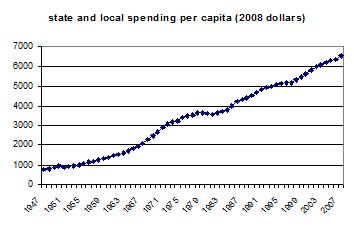
[revised, 10:30 am Eastern Time] The growth has been fairly continuous, apart from a dip in real spending in the Reagan years. Adjusted spending in 1982 was lower than in 1978, despite sharply increased need because of the recession. I don't know for sure, but I suspect that at other times, the growth has been driven by: health entitlements, prison costs, and higher education (in descending order of magnitude). Spending for other purposes is probably close to flat.
Both the standard liberal and conservative narratives are a little off. Liberals are wrong to say that we've just lived through a period of conservative retrenchment in which local and state governments have shrunk. Expenditures are much bigger in real terms than they were in the liberal 60s. But conservatives are wrong to complain about a growing "welfare state." If most expenditures cover prisons, education for relatively advantaged young adults who can attend college, and medical technology, this is hardly "welfare"--even broadly defined.
The data I could find ended in 2007. We'll see what happens next.
Posted by peterlevine at 11:25 AM | Comments (0) | TrackBack
June 22, 2009
in-flight nostalgia
(On a plane from Boston to San Francisco) I spent every childhood summer in England--in a different home almost each year--and have returned there repeatedly in adulthood. Whenever a long time passes without a visit, I feel subtle nostalgia growing. Here's the kind of thing I miss:
A summer morning, cool enough to require a sweater and jacket outside. The sky has been light since 4 am. The bathroom window is almost always a frosted pane of glass on a hinge, set in a thick stone wall. There's no screen, because there are hardly any mosquitoes. Open the hinge and damp air flows in, carrying strong smells of pollen, rich soil, and new growth--even in the heart of London, although there you can detect engine exhaust as well.
The hot and cold water flow from separate taps, the hot coming directly from a gas heater overhead. It steams in the sink. There's never a shower, just an elaborate coil of metal pipes that hangs on the side of the tub along with a steel basket for the soap. Because of the high voltage, the electrical outlets are big plastic boxes with on/off switches. Layers of paint cover old wallpaper; wires are tacked to the baseboards. Cleansers give the room an ineffably British smell.
The staircase is long and narrow. Bacon is thick and intensely salty. Tea is strong. The insides of the mugs are tea-stained. The grass is luxuriously thick and green. Cumin wafts from restaurant doors, and the glittering cement pavements are sticky from last night's spilled beer. An unmarked white delivery van rushes past, pinning you against a bowed stucco wall. Tattered music billboards, surveillance cameras, Oxfam and Barclay's Bank on the High Street, black fences topped with spears, zebra crossings, beds of lavender and rosemary bushes.
Posted by peterlevine at 7:29 PM | Comments (0) | TrackBack
June 19, 2009
people power in Iran
(Hartford, CT) I think the Iranian regime has doubled down, betting the very principle of clerical authority on the assumption that they can crush or outlast the protests. Ayatollah Khamenei denied that the election could have been rigged: "There is 11 million votes difference," he said. "How can one rig 11 million votes?" He could have kept a low profile, called for negotiations, or tried to persuade one of the candidates to quit. Instead, he decided to force the issue. Evidently, either ...
1. The election was rigged at a high level, not where the ballots were collected but where the results were announced. In that case, the whole regime is illegitimate on its own terms. Or ...
2. President Mahmoud Ahmadinejad actually got the most votes, but there is still massive discontent, probably because the field of candidates and issues was sharply limited in the first place.
The two outcomes that I have seen discussed most are a victory for Khamenei, Ahmadinejad, and the militias, followed by further repression, or a victory for Mir Hossein Mousavi, whose policies would be incrementally less bellicose and more liberal. But I think there are several other possible outcomes, including a rapid drift in a more liberal direction (out of Mousavi's control); a rapid drift in a different direction, such as toward some kind of left-populism; or a long period of conflict, including possibly a civil war. We should all wish the Iranian people the best in this critical, dangerous, hopeful moment.
Meanwhile, I continue to be moved by the self-discipline of their massive popular movement. According to a Mousavi supporter quoted by Juan Cole:
... the dynamics of this movement are becoming more and more creative. From the moment everybody embraced silence as the best form of criticism, supporters from their cars switched from honking their horns to using their flasher. Last night, as I drove home, I noticed the blinkers in oncoming traffic (coming actually from the direction of Haft-e Tir Square). I didn’t take long to spread the message. Soon, everyone around was switching their flasher on, an act reflective of a truth that has been firmly established now after five consecutive days of protest: silence is speaking very loudly indeed. ...
The posters of Mousavi of day one have given way to posters expressing deeper themes, and the deeper problems that exist in this country. “Democracy does not equal Dead Student”, “Stop Killing Us”, “We are not rioters”, “Silence is not acceptance”, “The key to victory: Calmness, Hope and Patience”. ...
About the march: it was entirely silent and peaceful.
Posted by peterlevine at 7:03 PM | Comments (0) | TrackBack
June 18, 2009
conference on the Obama civic agenda

Please save the date
The Obama Administration's Civic Agenda After Six Months
A Public Discussion Convened by the
Jonathan M. Tisch College of Citizenship & Public Service
July 24, 12:00-2 pm, Tufts University
|
"I have no doubt that in the face of impossible odds people who love their country can change it. But I hold no illusions that one man or woman can do this alone. That's why my campaign has called nearly 400,000 Americans to a common purpose. That's why I'm reaching out to Democrats, and also to Independents and Republicans. And that is why I won't just ask for your vote as a candidate; I will ask for your service and your active citizenship when I am President of the United =
States. This will not be a call issued in one speech or program; this will be a
central cause of my presidency."
-- Senator Barack Obama, December 5, 2007 |
To discuss these questions in a public forum:
Alan D. Solomont, Keynote Speaker
Chair, Corporation for National and Community Service
Harry Boyte, University of Minnesota
Archon Fung, Harvard University
Marshall Ganz, Harvard University
Peniel Joseph, Tufts University
Peniel Joseph, Tufts University
Carolyn J. Lukensmeyer, AmericaSpeaks
Carmen Sirianni, Brandeis University
And others to be named
This event is the capstone of the first annual Summer Institute of Civic Studies at the Jonathan M. Tisch College of Citizenship & Public Service. Participants in the Institute--an intensive, 2-week seminar at Tufts--are graduate students and faculty from many disciplines and universities. Each year the Institute will conclude with a public conference on a timely topic related to civic engagement.
Visit our website to sign up to receive updates about this event.

Posted by peterlevine at 10:18 AM | Comments (0) | TrackBack
June 17, 2009
self-limiting popular politics
In this remarkable video from Italian TV, Iranian motorcycle police attack a group of peaceful protesters. The protesters respond with stones and manage to turn at least one motorcycle into a flaming wreck. You can then see them escort the lightly wounded police officer to safety and give him water. The informal rule that seems to have developed is: Hurt the machines, love the human beings.
This is a great example of what I wrote recently in connection to the Palestinian cause. Social movements must limit themselves or they are likely to spin out of control and destroy their own purposes and their own people. Perfect nonviolence is one example of self-limitation, but it is not the only one. Destroying motorcycles is violent (and could certainly harm the riders), but it can be done in a limited way. As Bhiku Parekh writes in his book Gandhi: A Very Short Introduction (p. 60), "Gandhi's satyagraha has much to be said for it, but it cannot be a catholicon. Although Gandhi insisted otherwise, violence need not be accompanied by hatred to ill-will or be uncontrolled. Like non-violence it too can be restrained, measured, born out of love for both the victims and perpetrators of injustice, and used to arrest human degradation." There couldn't be a better illustration than this video.
Posted by peterlevine at 10:08 AM | Comments (0) | TrackBack
June 16, 2009
open source politics
(heading back to Boston from the Midwest) I've been thinking about when it's a good idea to develop knowledge in an open way--by inviting anyone to contribute to a common pool. Wikipedia is a remarkable resource that has been built by volunteers who not only write, but also edit others' work. Google often leads you quickly to the best information, even though nobody sits at Google's HQ writing websites or picking the best ones. Google's search results are driven by choices that millions of other people have made.
Yet the White House's recent open discussion of "transparency" was quickly dominated by people who wanted Barack Obama's "real" birth certificate to be released. Their comments couldn't be deleted as irrelevant, because they did have a concern about transparency. I think their concern was simply embarrassing (to them), but I don't get to decide what's valuable or ridiculous in an open forum. The whole discussion was mostly unhelpful, in my opinion, because they dominated.
I recently visited Project Vote Smart, which employs hundreds of college students every year to collect and code candidates' position papers, speeches, and votes. This is a labor-intensive model that is threatened by automated systems that promise equally good results without human labor. Yet I suspect that the careful work of Project Vote Smart is indispensable. I doubt that we can rely on a wiki or a search engine to provide reliable information about local candidates.
Reflecting on these examples, I would propose three general principles for deciding when to use an open process:
1. It works best when value-conflicts are minor or absent and information is the main issue. That means that an open process works better in science and technology than in politics or religion.
2. It works best when millions of people participate, because they can swamp small groups of cranks. But in American politics, below the presidential level, millions of people do not participate actively. An open forum about a candidate for state legislature, for instance, is likely to draw just a handful of actual contributors.
3. It works best when stakes are relatively low. If I organized a public discussion of transparency on this website, there would be few participants, but their comments would probably be well-intentioned and thoughtful. There would be no motivation to disrupt a discussion on my personal website, because my site has little or no political importance. But if the White House organizes a discussion, all of its political opponents have motives to disrupt it. The White House is powerful, and it has enemies. When power and conflict are involved, many of the old rules of politics reassert themselves--even online.
Posted by peterlevine at 8:26 AM | Comments (0) | TrackBack
June 15, 2009
ethics from nature (on Philip Selznick)
(en route to the Midwest for a service-learning meeting.) Here is a fairly comprehensive ethical position. It is my summary of Philip Selznick's The Moral Commonwealth, chapter 1, which is presented as an interpretation of Dewey's naturalistic ethics. I have not investigated whether Selznick gets Dewey right--that doesn't matter much, because Selznick is a major thinker himself. His position has just a few key ingredients:
1. "The first principle of a naturalist ethic is that genuine values emerge from experience; they are discovered, not imposed" (Selznick, p. 19). So we shouldn't expect to ground ethics in a truth that is outside of experience, as Kant advised.
2. Experience is the understanding of nature, broadly defined. Such experience has moral implications. There is "support in nature for secure and fruitful guides to moral reflection and prescription" (p. 27). Yet "humanity is in the business of amending nature, not following it blindly" (p. 18).
3. The study of nature that we need for ethics is more like "natural history" than "theoretical science." In other words, it looks for generalities and patterns, but it doesn't assume that true knowledge is highly abstract and universal. "For modern theoretical scientists, nature is not known directly and concretely but indirectly and selectively. Ideally embodied in mathematical propositions, nature becomes rarified and remote. In contrast, students of natural history--naturalists--are interested in the situated wholeness of objects and organisms. They perceive a world of glaciered canyons, burnt prairies, migrating geese." They exhibit "love for the world" (p. 26).
4. Certain facts about human beings (not to be sharply separated from other natural species) emerge from such empirical observation and are ethically important. For instance, human beings have a potential for growth or development in interaction with community, and such growth gives us well-being. "When interaction is free and undistorted--when it stimulates reflection and experiment--powers are enhanced, horizons expanded, connections deepened, meanings enriched. Growth depends on shared experience, which in turn requires genuine, open communication" (pp. 27-8).
Dewey/Selznick begin with observable facts about us as a natural species, identify growth as a "normative idea" (p. 28), and are soon on their way to strong ethical conclusions. For instance, Dewey claimed that democracy is the best system of government because it permits free collective learning; but a democracy is desirable to the extent that discussion and experimentation prevail (rather than the mere tabulation of votes).
This approach suggests that it's better to "benchmark" than to set ideals. That is, it's better to assess where we are as a species, or as a community, or as an individual, and then try to enhance the aspects that seem best, rather than decide what a good society or a good character should be like in principle. Dorf and Sabel have tried to work out a whole political theory based on this distinction. (Link opens a Word doc.)
I find Selznick's view attractive, but I have two major methodological concerns. First, I'm not sure that the selection of natural features is as straightforward as Selznick and Dewey presume. We are naturally capable of learning together in cooperative groups, thereby developing our own competence and enriching our experience. We are also capable of exploitation, cruelty, faction, brutality, and waste. These all seem equally "natural." I suspect the pragmatist's preference for "growth" is closer to a classical philosophical premise than a naturalist observation. In fact, it sounds a lot like Kant's requirement that we develop ourselves and others.
We could read Dewey's conclusions as simply a contribution to public debate. He likes "growth"; others can discuss his preference. If we reach consensus within our community, we have all the ethical certainty we need. If we disagree, our task is to discuss.
That's all very well as long as we recognize that consensus is highly unlikely. (This is my second objection.) Imagine Dewey in a debate with an Iranian Ayatollah. The latter would reject Dewey's method, since revelation should trump experience; Dewey's understanding of natural history, since the world began with creation and will end apocalyptically; and Dewey's goals, since salvation after death is much more valuable than growth here on earth. No experience can directly settle this debate, because we only find out what happens after death after we die. And until the Mahdi actually returns, it's possible that he is waiting.
But here's an argument in favor of Dewey's method. The debate is not just about abstract principles and unfalsifiable predictions. It's also about how principles play out in real, evolving institutions. So we should compare not just the metaphysics of a Shiite Ayatollah and an American pragmatist, but also the institutions that each one endorses: contemporary Iran versus a Deweyan model, such as a laboratory school or a settlement house. It seems to me that contemporary Iran is not doing very well, and Dewey has a "naturalist" explanation of why not. The fundamental principles of the Iranian revolution are not in sync with nature. That's not going to persuade a diehard revolutionary, because he will expect everything to improve as soon as the Mahdi returns. But it is an observation that a devout Shiite can accept and use as an argument for reform. Thus there is a meaningful debate between reformers like Khatami and diehards like Ahmadinejad. If Khatami ultimately wins, score one for Dewey and Selznick, because Iran will have turned out to be governed by natural laws of growth and reflection.
Posted by peterlevine at 12:06 AM | Comments (0) | TrackBack
June 12, 2009
a theory of familiarity
Let's say that a place is perfectly familiar to you if you hardly notice you're there. You can walk from one room of your house to another without using any mental resources to find your way, and if things haven't changed, you hardly register the environment. I became so familiar with my Metro commute to College Park, MD--45 minutes each way for 15 years--that I often didn't even notice changing trains at Fort Totten. I would have to look up to see if I had already shifted from the Green to the Red Line. Even accounting for some eccentricity on my part, I think this is a general phenomenon: We save our attention for what is new and requires thought.
I'm interested in when we reach a stage of familiarity. It doesn't seem to take all that many hours. For instance, I would guess I spend an average of 2-3 hours per week on airplanes. Each plane is different. Yet that's enough time to make the situation familiar once I settle into my seat. The context pretty much disappears and I can be fully absorbed in reading, thinking, or talking. So I think familiarity increases on a steep curve.
But then it matters how much time passes between experiences. My mother-in-law's house in Georgia feels extremely familiar to me. I've spent no more than two percent of my time there since the mid-1990s, but our visits have been spaced fairly evenly over the years. Returning for a couple of days every 3-6 months seems to be sufficient to retain a sense of familiarity. In contrast, if we had spent three months there in 1996 and never returned, I'm pretty sure it would feel unfamiliar.
There is surely some individual variation in how we experience familiarity. I am not sure how I'd like to be in this respect. Attaining familiarity seems desirable, insofar as it reduces stress and distraction and lets us focus on our choice of tasks. At the same time, it seems bad when it makes us careless or inattentive to the world or when it makes time pass too quickly.
Posted by peterlevine at 11:23 AM | Comments (0) | TrackBack
June 11, 2009
talk to the White House about civic learning
As I've discussed before, the White House Office of Public Engagement has organized an elaborate online discussion to provide guidance on how to enhance transparency, participation, and collaboration in the federal government. More than 2,000 ideas were submitted and discussed in the first round. Of these, the Office has selected a few for further discussion online.
One cluster of ideas that they have selected involves civic education, which is the topic of the day today. It would be helpful if people who care about civic education weighed in, especially since some previous discussions have gone off on tangents. Here's where you go to comment.
This is the original announcement from the White House (issued yesterday):
- Provide a toolkit, including neutral discussion guides, to facilitate community discussions and a website for groups to share conclusions.
- Invest in educating Americans (e.g. through town halls) to analyze complex information.
- Train neighborhood facilitators to use proven dialogue methods that engage a group in 3 hours or less.
- Establish listening and personal story sharing skills workshops in homes & schools.
- Create and sponsor teen model governments to seek solutions.
- Combine deliberation and service on Martin Luther King Day and other holidays.
On Thursday, June 11th, we’ll turn from talking about how government can create better opportunities for participation to address how to promote the civic literacy needed to participate effectively in government. On Promoting Civic Education, you said:
I like these ideas--in fact, I originally proposed at least one of them--but there's a need to think bigger and to focus more on schools (which is where the kids are!). Furthermore, the actual White House post highlights civic education less than yesterday's announcement suggested it would. That's not a big deal, but I would like to see the discussion shift toward school-based civic education. To that end, I have posted the following; other perspectives would be welcome as well:
Young people can learn to be very effective and helpful participants in public dialogs. Moderated discussions of current events in school, high-quality community service projects with a dimension of research and planning, youth production of news media, and youth service on boards and committees have all been shown to teach relevant skills, knowledge, and values.
Unfortunately, such opportunities are distributed very unequally. Poor children, children in stressed schools, and children who are academically "at risk" rarely receive civic opportunities that are common in high-performing suburban schools. Unless we address this problem, we will miss the voice of low-income kids in any public process.
The federal government invests very modestly in civic education. We estimate that federal spending on all the relevant programs (in the Department of Education, Corporation for National and Community Service, HUD, and the National Endowment for the Humanities) totals about $2 per student per year. But that small investment could be much more valuable:
1. It should be an investment in innovation. Money should be allocated in open competitions, and grantees should have to evaluate impact rigorously so that the field can learn.
2. It should be coordinated. There should be more integration, especially between the civic education programs of the Department of Education and NEH and the service-learning programs of the Corporation for National and Community Service and HUD.
3. It should be connected to the kind of work that the White House Office of Public Engagement is doing. When the government seeks public involvement in policymaking, students should be included, and they should have opportunities to learn civic and deliberative skills.
Posted by peterlevine at 8:47 PM | Comments (0) | TrackBack
June 10, 2009
beyond civic piety
"Never doubt that a small group of thoughtful, committed citizens can change the world. Indeed, it's the only thing that ever has." --Margaret Mead
This is one of the most popular quotations in my world. I can't count how many times I've seen it printed out and hung on office walls. I think I understand the motivations that led Mead to say it. She was exhorting us to work together and make the world better.
But what she said isn't literally true. Technological changes, institutional inertia, markets, clashes of social classes and other demographic groups, disciplined organizations, violence, tyranny, and sheer accidents also "change the world." For instance, a big flood recently changed New Orleans a whole lot. It changed the city for the worse, and that brings up a separate problem with Margaret Mead's quotation. Changing the world is morally ambiguous--it can be good or bad. The World War I veterans who gathered around Mussolini and Hitler were "small group[s] of ... committed citizens," and they made the world a lot worse. I deleted the word "thoughtful" in describing them, but they did think a lot about social issues and strategies. They just thought in a bad way.
I don't mean to take cheap shots at Margaret Mead, but rather to emphasize that we need a really serious investigation of these questions:
- When can "a small group of thoughtful, committed citizens" change the world?
- How can they be most effective?
- What are good means and good ends for these groups?
Of course, there is great writing on these topics, of which we selected some favorite texts for our Summer Institute's syllabus. But I believe there is much less scholarship than you would expect, for these reasons:
1. Addressing these questions requires a mix of facts and ethics, "is" and "ought" (or, in academic jargon, empirical and normative discourse); and that mix is rare. The social sciences are still heavily positivist and unable to deal openly with normative questions. Political philosophy is too abstract and not informed enough by practical experience.
2. Paying attention to the effects of small-group politics seems naive, since big, impersonal social forces probably have more impact on outcomes. Academic "realism" marginalizes human agency. But small-group politics is morally important--it's what we should do. It's also more significant than the "realists" believe, although less powerful than Margaret Mead implied.
3. Human agency takes place at a moderate scale. It's not just "micro"--a matter of individual choices such as whether to lie, or to vote, or to use birth control. It's also not just "macro," involving the basic structure of a whole society. We human beings cannot directly change basic structures, but we can do more than make individual choices. We can work in political groups. Somehow, political theory and philosophy ignore the moderate scale in favor of the micro and the macro. (A exception, just to illustrate what we need more of, is this paper by Archon Fung.)
Posted by peterlevine at 12:00 PM | Comments (0) | TrackBack
June 9, 2009
war and peace
I like to mix the usual fare of "civic engagement" and current events that dominate this blog with a smattering of culture. But I don't think there will be much of that this month. I'm just 240 pages into the recent translation of War and Peace by Pevear and Volokhnosky. If I have anything to say about Tolstoy, it will probably be after I'm done. For now, I'm having enough trouble keeping the characters straight. Is Nikolushka the same as Nikolenka, and is he also Count Nikolai Ilyich? (Yes.) Is Count Nikolai the same as Prince Nikolai? (Nope.) Who is the brother of Princess Elizaveta Karlovna (a.k.a. Liza, Lizaveta, or Lise), and is he also the brother of Princess Elena Vassilievna (a.k.a. Lelya, Helene)? (Absolutely not.) Sometimes I'm tempted to just let it all wash over me, but I've found that's almost always a mistake when you read sprawling 19th-century novels. Sooner or later, there will be some crucial connection that makes everything suspenseful and significant, if only you noticed it. So was that Pyotr Kirillovich (Pierre) or Pyotr Ilyich (Petya) whom Natalya (Natasha, Natalie) met in Moscow?
Posted by peterlevine at 7:50 AM | Comments (0) | TrackBack
June 8, 2009
summer institute of civic studies at Tufts
We are gearing up for the first annual Summer Institute of Civic Studies at Tufts University's Tisch College of Citizenship and Public Service. We have enrolled about 25 graduate students from universities across the country (and a few overseas visitors).
Designing the curriculum has been an exercise in deciding what is central and what is peripheral to the study of active citizenship. What is most important to know if you want to be an active, effective, member of a community? That question could be asked in various contexts. For instance, high school students should probably learn different things from adult activists who want become more effective citizens. We have been focused on students in PhD programs, whose interests will be relatively academic and theoretical. I am looking forward to a rich debate about what is most important for these PhD students to learn if they choose to study active citizenship. Our syllabus represents just one answer to that question. I have posted it below the fold.
Summer Institute for Civic Studies
Tisch College of Citizenship and Public Service, Tufts University
Instructors: Steve Elkin (SE), Peter Levine (PL), Karol Soltan (KS)
Outline of Seminar Sessions and Readings
July 13
Introductions and Opening Comments (9:45-10:15)
Seminar on Civic Theory (10:30 am – 12:30 pm)
Introduction (PL, KS)
Readings:
- Vaclav Havel, Address at Wroclaw University (December 21, 1992)
- Vincent Ostrom, “Citizen Sovereigns…” (2005 John Gaus Lecture), PS, 39 (2006): 13-17
Topic: Institutional design (I) -- Collective-action problems and solutions (PL, KS)
Readings:
- Thomas Dietz, Nives Dolsak, Elinor Ostrom, and Paul C. Stern, “The Drama of the Commons,” in Elinor Ostrom, ed., Drama of the Commons, pp. 3-26.
- John Gaventa, Power and Powerlessness: Quiescence and Rebellion in an Appalachian Valley, pp. 3-32.
Topic: The citizen in development (PL)
Readings:
- Michael Schudson, The Good Citizen, pp. 1-10, 188-232
- Joel Westheimer and Joseph E. Kahne, “Educating the ‘Good Citizen’: Political Choices and Pedagogical Goals,” PS Online
- Constance Flanagan, “Developmental Roots of Political Engagement,” PS: Political Science and Politics, 36 (2), 257-261.
Civic Topics: Discussions with invited speakers (4:30-6 pm)
Professor Carmen Sirianni, Brandeis University, on collaborative governance
July 14
Seminar on Civic Theory (10am - noon)
Topic: Institutional design (II) – exchange, authority and persuasion (KS).
Reading:
- Charles Lindblom, Politics and Markets, Chapters 1-4, pp. 3-62
Seminar on Civic Practice: The venues of civic work (2-4 pm)
Topic: Deliberation and negotiation (PL, KS)
Readings:
- Roger Fisher and William Ury, Getting to Yes (2d ed.), Chapter 1 “Don’t Bargain Over Positions” pp. 3-14.
- John Gastil, Political Communication and Deliberation, pp. 3-38.
- Archon Fung, “Recipes for Public Spheres: Eight Institutional Design Choices and Their Consequences” in Journal of Political Philosophy, vol. 11, No. 3. (September 2003), pp. 338-67.
- Bernard Manin “Deliberation: Why We Should Focus on Debate Rather Than Discussion.”
Civic Topics: Discussions with invited speakers (4:30-6 pm)
Professor Archon Fung, Harvard University, on participation and deliberation in democratic governance.
July 15
Seminar on Civic Theory (10am - noon)
Topic: Putnam and social capital (PL)
Readings:
- Robert D. Putnam, “Community-Based Social Capital and Educational Performance,” in Ravitch and Viteritti, eds., Making Good Citizens, pp. 58-95;
- Jean L. Cohen, “American Civil Society Talk,” in Robert K. Fullinwider, ed., Civil Society, Democracy, and Civic Renewal, pp. 55-85.
Seminar on Civic Practice: The venues of civic work (2-4 pm)
Topic: Public work (PL)
Reading:
- Harry C. Boyte and Nancy N. Kari, Building America: The Democratic Promise of Public Work, pp. 1-32
- Carmen Sirianni and Lewis A. Friedland, The Civic Renewal Movement: Community-Building and Democracy in the United States, pp. 118-148
Civic Topics: Discussions with invited speakers (4:30-6 pm)
Professor Richard Lerner, Tufts University, on Positive Youth Development and its implications for civic engagement
July 16
Seminar on Civic Theory (10am - noon)
Topic: Habermas and the critical theory
Readings:
- Jurgen Habermas, “The Public Sphere: An Encylopedia Article,” New German Critique, 3 (1974), pp. 49-55;
- Nina Eliasoph, Avoiding Politics, pp. 1-22.
- James Finlayson, Habermas: A Very Short Introduction, Chapters 1, 2, 4 (pp. 1-27, 47-61);
- “Critical Theory,” Stanford Encyclopedia of Philosophy online.
Seminar on Civic Practice: The venues of civic work (2-4 pm)
Topic: Social movements (KS)
Readings:
- Bikhu Parekh, Gandhi, Chapter 4 (“Satyagraha”), pp. 51-62;
- Berel Rodal, “Bottom-Up, Inside-Out: The Record and Potential of Civilian-Based Non-violent Power…”
- Peter Ackerman, “Skills or Conditions: What Key Factors Shape the Success or Failure of Civil Resistance?”
- Marshall Ganz, “What Is Public Narrative?”
- Marshall Ganz, “Why David Sometimes Wins: Strategic Capacity in Social Movements”
Civic Topics: Discussions with invited speakers (4:30-6 pm)
Professor Kent Portney, Tufts University, Community Participation and Sustainable Cities
July 17
Seminar on Civic Theory (10am - noon)
Topic: Unger and radical democracy (KS)
Readings:
- Roberto Unger, Social Theory: Its Situation and Its Task, Introduction (pp. 1-17), Chapter 6 (pp. 80-169)
- Roberto Unger, Democracy Realized “A Manifesto” (pp. 263-77)
Seminar on Civic Practice: The venues of civic work (2-4 pm)
Topic: Community organizing (PL)
Reading:
- Mark R. Warren, Dry Bones Rattling, pp. 3-71;
- Carmen Sirianni and Lewis A. Friedland, The Civic Renewal Movement: Community-Building and Democracy in the United States, 15-42.
No Civic Topics: Weekend break
July 20
Seminar on Civic Theory (10am - noon)
Topic: Flyvbjerg and social science as phronesis (KS)
Readings:
- Bent Flyvbjerg, “Social Science that Matters” (2006)
- Bent Flyvbjerg, “Making Organization Research Matter: Power, Values and Phronesis” (2006)
- David Garvin, “Making the Case”
- Robert Bellah et al. Habits of the Heart, Appendix (pp. 297-307).
Seminar on Civic Practice: The venues of civic work (2-4 pm)
Topic: The American regime (SE)
Readings:
- The Federalist, numbers 9, 10, 51
- Stephen Elkin, Reconstructing the Commercial Republic, Chapters 2-3 (pp. 19-73).
- Jennifer Nedelsky, Private Property and American Constitutionalism, Chapters 1-2 (pp. 1-66).
Civic Topics: Discussions with invited speakers (4:30-6 pm)
July 21
Seminar on Civic Theory (10am - noon)
Topic: Madison and thinking constitutionally (SE)
Readings:
- Stephen Elkin, Reconstructing the Commercial Republic, Chapters 4-5 (pp. 74-146)
- James Ceaser, “Reconstructing Political Science” (pp. 41-69)
- Edwin Haefele, “What Constitutes the American Republic?” (pp. 207-31) in Elkin and Soltan, eds, A New Constitutionalism
- Lon Fuller, “Ends and Means” in Winston, ed., Principles of Social Order, pp. 47-64.
Seminar on Civic Practice: The venues of civic work (2-4 pm)
Topic: In the Shadow of Civil War (KS)
Readings:
- Arend Lijphart, “Constitutional Design for Divided Societies,” Journal of Democracy, 15(2004): 96- 109;
- Donald Horowitz, “Conciliatory Institutions and Constitutional Processes in Post-Conflict States,” William and Mary Law Review, 49 (2008): 1213- 1248.
- Kader Asmal, “Truth, Reconciliation, and Justice: The South African Experience in Perspective,” Modern Law Review, 63 (2000): 1-24.
Civic Topics: Discussions with invited speakers (4:30-6 pm)
Professor Meira Levinson, Harvard University, on inequality in civic education
July 22
Seminar on Civic Theory (10am - noon)
Topic: Selznick and normative sociology (KS)
Readings:
- Philip Selznick, The Moral Commonwealth, Preface (p. ix-xiv), Chapter 1 (pp 3-38), Chapter 9 (pp. 231-64), Chapter 11 (pp. 289-309)
Seminar on Civic Practice: The venues of civic work (2-4 pm)
Topic: The world (KS)
- Singer, One World, 2d. ed. Chapter 5 (“One Community”), pp. 150-195;
- Michael Ignatieff , “The Attack on Human Rights,” Foreign Affairs, 80.2 (2001): 102-17;
- Richard Rorty, “Human Rights, Rationality, and Sentimentality.”
- James Speth, The Bridge at the Edge of the World, Chapter 10 (pp. 165-82);
- Universal Declaration of Human Rights
- The Earth Charter
Civic Topics: Discussions with invited speakers (4:30-6 pm)
Elizabeth Lynn, Director of the Project on Civic Reflection
July 23
Seminar on Civic Theory (10am - noon)
Topic: Alinsky (and others), popular education and organizing (PL)
Readings:
- Saul Alinsky, Reveille for Radicals, 1946 (1969 edition), pp. 76-81; 85-88; 92-100, 132-5, 155-158.
- Myles Horton and Paulo Freire, We Make the Road by Walking, pp. 115-138
Seminar on Civic Practice: The venues of civic work (2-4 pm)
Topic: The Obama presidency (PL)
Readings:
- Senator Barack Obama, “A New Era of Service,” July 2, 2008
- Memorandum on “Transparency and Open Government”
- White House Open Government Initiative
- “Champions of Participation”
Civic Topics: Discussions with invited speakers (4:30-6 pm)
Marshall Ganz, Harvard University, community organizing
July 24
Concluding Public Conference
The Obama Administration’s Civic Agenda After Six Months
Friday, July 24, noon - 2:30 pm
Speakers:
Alan Solomont
Chair of the Corporation for National and Community Service
Harry Boyte
University of Minnesota
Archon Fung
Harvard University
Marshall Ganz
Harvard University
Peniel Joseph
Tufts University
Xolela Mangcu
University of Johannesburg
Carmen Sirianni
Brandeis University
And others to be announced
Posted by peterlevine at 12:00 AM | Comments (0) | TrackBack
June 5, 2009
a community organizing primer
This year is the centennial of Saul Alinsky's birth. Also in 2009, another Chicago community organizer was elected president of the United States--the first person with such a background to reach the White House. Meanwhile, one group with at least peripheral connections to both Alinksy and Obama--ACORN--has become a political hot-button. Yet we know from last year's Civic Health Index (for the National Conference on Citizenship) that the vast majority of Americans have no idea what "community organizing" is. In an open-ended question, most people either cited local philanthropic behavior (like raising money for the PTA) or said they didn't know what the phrase meant.
I know much less about community organizing than many others (including some who read this blog). But for newbies, the most important point I'd want to convey is the vast diversity of forms of community organizing. It is a contested term for a field full of controversy. At the risk of oversimplification, here are some types:
Strategic organizing starts with some kind of policy agenda, such as saving civilization by reducing carbon emissions or saving unborn children by ending abortion. Strategic organizers need to recruit and motivate strong supporters, find non-supporters who might be persuadable, and mobilize people who have special assets to contribute to the cause (e.g., money, skills, serious commitment, network ties, or fame).
Strategic organizing has a family resemblance to ideological organizing and partisan organizing. Indeed, parties and campaigns use community organizing techniques. I would nevertheless make distinctions here. Causes, ideologies, parties, and candidates are different things, and sometimes there are intense conflicts among them.
Relational organizing doesn't start with a cause, but rather with a set of people--for instance, all the residents of a neighborhood or all members of a congregation. There is usually a long initial process of listening and discussing to decide what the common cause should be. Because the commitment is to relationships, not to predetermined outcomes, organizers do not select which individuals to mobilize because of what they can contribute to the cause. There is an ethical commitment to the relationship itself that can survive differences of opinion or failure to contribute effectively to the cause.
Relational organizing can occur within a homogeneous group, but it's related to broad-based organizing, in which there is a commitment to connect and listen to all sectors or perspectives within a geographical community. A broad-based organizer will want to make sure that liberals, conservatives, industries, environmentalists, religious and secular people are all "at the table." In deliberative organizing, as practiced by Everyday Democracy and a few other groups, diverse conversations become the central objective. In other broad-based organizing efforts, advocacy takes more time than discussion, but one purpose of the advocacy is to build ties among diverse groups.
Yet another distinction is confrontational organizing (in which conflicts and flash-points are used to build momentum) and more collaborative approaches.
Roughly speaking, groups like ACORN are strategic, confrontational, and ideological. Groups like PICO, Gamaliel, and much of IAF are relational and broad-based. There are also many internal debates and compromises.
Posted by peterlevine at 12:21 PM | Comments (1) | TrackBack
June 4, 2009
open covenants of peace
According to Ethan Bronner in the New York Times, "Senior Israeli officials accused President Obama on Wednesday of failing to acknowledge what they called clear understandings with the Bush administration that allowed Israel to build West Bank settlement housing within certain guidelines while still publicly claiming to honor a settlement 'freeze.'"
If the Bush Administration really endorsed such understandings, shame on them. Expanding the settlements at all violates the interests of the Palestinians, the United States, and, in my opinion, Israel. What's more, the Administration's actions would then be contrary to what it told the American people and the world. That would be both dishonest and undemocratic. The opposition (including Senator Barack Obama) could not even criticize the Bush policy if it was secret and contrary to what the Bush administration was claiming publicly.
As the first of his famous Fourteen Points, Woodrow Wilson called for "Open covenants of peace, openly arrived at, after which there shall be no private international understandings of any kind but diplomacy shall proceed always frankly and in the public view."
Probably, Wilson was too idealistic. I can concede that sometimes governments must strike private deals or understandings. But here is a super-modest, minimalist Wilsonian principle to guide the Obama Administration:
"When one US administration strikes a private deal contrary to its public posture, that deal has no moral or legal force for the administration that succeeds it."
Posted by peterlevine at 11:51 AM | Comments (0) | TrackBack
June 3, 2009
on the limits of online forums
The White House recently created a space where anyone could post "ideas and comments on how to make government more transparent, participatory and collaborative." More than 2,000 ideas were posted. I was happy to participate; my ideas are here.
The site is a gesture in favor of openness, deliberation, and interactivity. But the results so far are at least somewhat problematic. They underline the importance of deliberations or discussions in which the participants are representative of the whole population and there is some moderation.
The very top vote-getter was proposed by "republicanleaderjohnboehner." It is a "72-hour mandatory public review period on major spending bills." I do not know whether that is a good idea. The explanation seems a bit partisan: the main example of a "taxpayer-funded outrage" is "the empty 'Airport for No One' in the congressional district of Democratic Rep. John Murtha (D-PA)." (Note the double identification of Rep. Murtha as a Democrat--both before and after his name.) 1201 people voted for this idea, 187 against it.
The Republican House leader had a right to participate in this dialogue; arguably, it is a good innovation to create an open space where he would be able to weigh in. But without prejudice against Mr. Boehner's idea, I suspect that it got so many votes because someone activated an an online Republican network to support it.
The second-rated idea was to legalize marijuana, which seems unrelated to the purpose of the site and must also reflect the activation of a network or a mailing list. It could indeed turn out that the number of votes was proportional to the size of one's network. (I used my blog and facebook page and got a total of 139 favorable votes.)
There were many cranky "proposals." For instance, 53 voted for, and 10 against, a proposal headed, "Obama may be Kenyan. His father is Kenyan. Obama is not natural born! Release [birth certificate]." My proposal to engage young Americans got comments like this one: "Stop spending money on racist preemtive genocidal wars. We need education not war." Whoever wrote this comment had a right to express himself. I disagree that the current US wars are "genocidal," but I'm not on the opposite side from this person. I would question whether (a) the comment was germane and relevant, and (b) whether a dialogue in which such views are prevalent can possibly influence national policy.
The important next step of the White House process is a "discussion phase." It will be very interesting to see how this works.
Posted by peterlevine at 2:09 PM | Comments (0) | TrackBack
June 2, 2009
it's a great country

That's me, hard at work yesterday morning at Project Vote Smart's HQ in Montana. By later that day, I was in my old home town of Washington, DC, walking near Dupont Circle on a warm summer evening. By later this evening, I'll be home in a Massachusetts suburb, in a detached house with a driveway, nestled among tens of thousands like it.
I'm still impressed by the speed and ease of travel, but what really strikes me is the vast diversity of this country. Yesterday, as we drove in a pickup truck through a small town in Montana that looked like a place where Gary Cooper could still walk bowlegged out of the saloon, my driver noted that New York State is better than you'd think. Upstate, he said, there are lots of regular people--dairy farmers and the like. I happen to be from Upstate, but from a dense city built on auto parts and salt rather than milk. We've got all kinds of "regular people," and we're all part of one vast, complicated, interdependent whole.
Posted by peterlevine at 3:31 PM | Comments (0) | TrackBack
June 1, 2009
Obama's campaign commitments to active citizenship
(Deerlodge National Forest, Montana) In his presidential campaign, candidate Barack Obama made remarkable commitments to active citizenship, civic renewal, and civic education. Here is a compendium of his statements that we can use to inspire ourselves--and to hold the president accountable for his promises. The source of these quotations is the remarkable Project Vote Smart database, which includes transcripts of thousands of candidates' speeches and releases.
02/10/2007 Springfield, Illinois, Remarks by Senator Barack Obama (D-IL) Announcing his Candidacy for President of the United States:
"And after a time, I came to understand that our cherished rights of liberty and equality depend on the active participation of an awakened electorate. (Cheers.)" ...
That's why this campaign can't only be about me. It must be about us. It must be about what we can do together. This campaign must be the occasion, the vehicle of your hopes and your dreams. It will take your time, your energy and your advice to push us forward when we're doing right and let us know when we're not.
This campaign has to be about reclaiming the meaning of citizenship, restoring our sense of common purpose, and realizing that few obstacles can withstand the power of millions of voices calling for change. (Cheers.) ...
That is our purpose here today. That is why I'm in this race, not just to hold an office but to gather with you to transform a nation. (Cheers.) ...
I want us to take up the unfinished business of perfecting our Union and building a better America. (Cheers.) And if you will join with me in this improbable quest, if you feel destiny calling and see, as I see, the future of endless possibilities stretching out before us, if you sense, as I sense, that the time is now to shake off our slumber and slough off our fears and make good on the debt we owe past and future generations, then I am ready to take up the cause and march with you and work with you. (Cheers.) Today, together, we can finish the work that needs to be done and usher in a new birth of freedom on this earth. ...
Thank you very much, everybody. Let's get to work. (Cheers.)"
3/19/2007 CNN, Larry King Live, answering a question about Michelle Obama:
"She's very interested in getting young people involved civically. She ran one of these AmeriCorps programs, called "Public Allies" in Chicago that helped young people connect with public service work and get leadership training. And so, she's really big on encouraging people to get involved in their communities. And I think that's something that she would be likely to continue if she were in the White House.
12/05/2007, Mt. Vernon, IA "Obama Issues Call to Serve, Vows to Make National Service Important Cause of His Presidency"
From the campaign press release: "Senator Barack Obama today issued a "Call to Serve" and detailed his commitment to making national service an important cause of his presidency in a major policy address at Cornell College in Mt. Vernon, Iowa.
In his campaign, Obama has enlisted hundreds of thousands of Americans to join him in working for change that America can believe in. As President, Obama will increase opportunities for Americans of all ages to serve their country. In his remarks, Obama discussed his personal experience in public service, as well as his plan to call on Americans from all walks of life to serve and to build an architecture that focuses their service toward achieving leading national goals.Today, it's easy for us to get caught thinking that there are two different stories at work in our lives. There is the story of our day to day cares and responsibilities. And there is the story of what's happening in the wider world - a story viewed through headlines and websites, a destiny to be shaped by forces beyond our control. ...
I am here today to ask you to reject this notion, and to invite you to take hold of the future of your country. Because your own story and the American story are not separate - they are shared. And they will both be enriched if we stand up together, and answer a new call to service to meet the challenges of our new century. ....
[as a community organizer] I found that you could do your part to see that - in the words of Dr. King - it "bends toward justice." In church basements and around kitchen tables, block by block, we brought the community together, registered new voters, fought for new jobs, and helped people live lives with some measure of dignity.
Eventually, I realized I wasn't just helping other people. Through service, I found a community that embraced me; a church to belong to; citizenship that was meaningful; the direction I'd been seeking. Through service, I found that my own improbable story fit into a larger American story."
From a transcript: "I have no doubt that in the face of impossible odds people who love their country can change it. But I hold no illusions that one man or woman can do this alone. That's why my campaign has called nearly 400,000 Americans to a common purpose. That's why I'm reaching out to Democrats, and also to Independents and Republicans. And that is why I won't just ask for your vote as a candidate; I will ask for your service and your active citizenship when I am President of the United States. This will not be a call issued in one speech or program; this will be a cause of my presidency."
06/30/2008, Independence, MO, Remarks of Senator Barack Obama:
"In spite of this absence of leadership from Washington, I have seen a new generation of Americans begin to take up the call. I meet them everywhere I go, young people involved in the project of American renewal; not only those who have signed up to fight for our country in distant lands, but those who are fighting for a better America here at home, by teaching in underserved schools, or caring for the sick in understaffed hospitals, or promoting more sustainable energy policies in their local communities.
I believe one of the tasks of the next Administration is to ensure that this movement towards service grows and sustains itself in the years to come. We should expand AmeriCorps and grow the Peace Corps. We should encourage national service by making it part of the requirement for a new college assistance program, even as we strengthen the benefits for those whose sense of duty has already led them to serve in our military.
We must remember, though, that true patriotism cannot be forced or legislated with a mere set of government programs. Instead, it must reside in the hearts of our people, and cultivated in the heart of our culture, and nurtured in the hearts of our children.
As we begin our fourth century as a nation, it is easy to take the extraordinary nature of America for granted. But it is our responsibility as Americans and as parents to instill that history in our children, both at home and at school. The loss of quality civic education from so many of our classrooms has left too many young Americans without the most basic knowledge of who our forefathers are, or what they did, or the significance of the founding documents that bear their names. Too many children are ignorant of the sheer effort, the risks and sacrifices made by previous generations, to ensure that this country survived war and depression; through the great struggles for civil, and social, and worker's rights.
It is up to us, then, to teach them. It is up to us to teach them that even though we have faced great challenges and made our share of mistakes, we have always been able to come together and make this nation stronger, and more prosperous, and more united, and more just. It is up to us to teach them that America has been a force for good in the world, and that other nations and other people have looked to us as the last, best hope of Earth. It is up to us to teach them that it is good to give back to one's community; that it is honorable to serve in the military; that it is vital to participate in our democracy and make our voices heard.
And it is up to us to teach our children a lesson that those of us in politics too often forget: that patriotism involves not only defending this country against external threat, but also working constantly to make America a better place for future generations."
09/12/2008 New York, NY:
"Every American can give back to their communities and help their fellow citizens through service," said Senator Obama. "Many Americans serve their nation through military service. Others serve by volunteering in schools, shelters, churches, hospitals, and disaster relief efforts. Still more are firefighters, teachers, or police officers. As a young man, I served as a community organizer on the South Side of Chicago, where I learned ways to create opportunities for other people to achieve their dreams. Our nation faces serious challenges in its neighborhoods and schools, and we must empower Americans with the resources they need to give back and improve their communities. I am proud to support this legislation and I commend Chairman Kennedy for his continued leadership in opening doors for public service opportunities."
04/29/2009 Town Hall Meeting, Arnold, MO:
"We're living through extraordinary times. We didn't ask for all the challenges that we face, but we're determined to answer the call to meet them. That's the spirit I see everywhere I go. That's the spirit we need to sustain, because the answer to our problems will ultimately be found in the character of the American people. We need soldiers and diplomats, scientists, teachers, workers, entrepreneurs. We need your service. We need your active citizenship."
01/21/2009 Remarks by the President in Welcoming Senior Staff and Cabinet Secretaries to the White House:
"Our commitment to openness means more than simply informing the American people about how decisions are made. It means recognizing that government does not have all the answers, and that public officials need to draw on what citizens know. And that's why, as of today, I'm directing members of my administration to find new ways of tapping the knowledge and experience of ordinary Americans -- scientists and civic leaders, educators and entrepreneurs -- because the way to solve the problem of our time is -- the way to solve the problems of our time, as one nation, is by involving the American people in shaping the policies that affect their lives."
Posted by peterlevine at 9:23 AM | Comments (0) | TrackBack