« April 5, 2005 | Main | April 8, 2005 »
April 6, 2005
Democrats on government waste
This is a fascinating chart from the Pew Research Center's "Trends" report.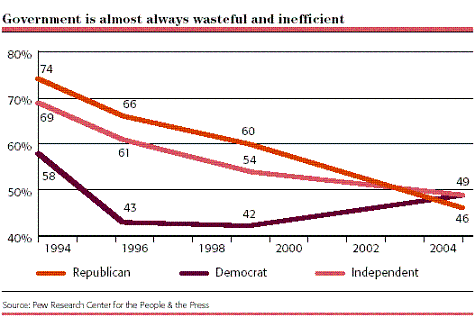
Once upon a time, a Democrat was someone who believed that most existing government programs were worthwhile. A Republican was someone who thought that most government programs were a waste of money. There is now no difference between the parties on this question, although Democrats are slightly more likely to view federal programs as wasteful.
I suspect that Republican voters became more positive about government after the Clinton-era welfare reform, which ended the traditional federal subsidy to poor women with children. Perhaps they became even more positive once their party ran the government, and the most conspicuous federal programs became the "war on terror" and the invasion of Iraq (plus Social Security and Medicare)--all of which they support.
Conversely, Democratic voters don't like the administration's foreign policy adventures or the people in charge of them, and that may be part of the reason that they see government as wasteful. But here's an additional hypothesis that would help explain the current weakness of the left. Many Democrats have come to see existing government programs--including welfare, education, health, and housing initiatives--as wasteful. This suspicion has a profound effect on politics; it means that a Democratic candidate cannot whole-heartedly or passionately advocate a different position from the Republicans'. Even his or her core constituency doesn't believe that government programs really get good results. The best that Democrats can do is what Kerry did in '04: talk vaguely about the need for health care reform, knowing pretty well than any particular legislation is dead on arrival. All that's left is the ethical commitment to universal health insurance without any confidence that it can be achieved.
I see two main responses: (1) Democrats and liberals are simply demoralized, led into pessimism and cyncism by years of anti-state propaganda. They need to snap out of it--not just the leadership, but also the voters. Or (2) existing federal programs have a record of wastefulness and damage that has become too hard to ignore. We just can't overlook farm subisidies, huge prisons, urban neighborhoods bulldozed by HUD, and even large school systems like the one my kid is in, with high per-pupil spending but insufficient money trickling down to classrooms. Furthermore, no one has shown us how federal money might solve problems like rust-belt unemployment, high crime and incarceration, or global poverty.
If (2) is true, the Democrats aren't going anywhere until they develop bold and persuasive plans for reforming government.
Posted by peterlevine at 8:33 PM | Comments (2) | TrackBack
Justice O'Connor on the independence of the judiciary
Last night, I attended Streetlaw's first annual awards dinner. As chair of the awards committee, I had the honor of presenting the Teacher of the Year award to Fred Cole from Marquette, Michigan, a fine social studies instructor who brings the Constitution alive in his classes.
Streetlaw's Chesterfield Smith award went to Justice Sandra Day O'Connor, who gave a speech about the rule of law. She emphasized the importance of civic education (in general) and Streetlaw's programs (in particular) as a foundation for a strong system of impartial justice. Before she took the podium, the American Bar Association President, Robert J. Grey, Jr., had given the evening's keynote address, in which he had explicitly criticized elected officials for trying to put pressure on the judiciary in the Terri Schiavo case. (Grey is quoted in today's New York Times on the same subject.) Justice O'Connor paused in the middle of her written defense of judicial independence to say (I paraphrase her closely): "And thank you, Robert Grey, for your earlier remarks on that subject. It's been a little troublesome lately in that respect."
When Congress passes a bill of attainder, attempting to coerce the judiciary to reach the conclusion it prefers, and then members of Congress explain the killing of judges as a reaction to public frustration with the judiciary, it's obvious what the true "conservative" response should be. Justice O'Connor provided it last night, in her pointed and rather tart defense of judicial independence, separation of powers, and rule of law.
(Senator Cornyn's full speech that caused all the controversy included some coveats and qualifications--and overlooked the Schiavo case completely. But there was an inflammatory passage that he must have expected to be noticed and quoted:
"Finally, I don't know if there is a cause-and-effect connection, but we have seen some recent episodes of courthouse violence in this country--certainly nothing new; we seem to have run through a spate of courthouse violence recently that has been on the news. I wonder whether there may be some connection between the perception in some quarters on some occasions where judges are making political decisions yet are unaccountable to the public, that it builds and builds to the point where some people engage in violence, certainly without any justification, but that is a concern I have that I wanted to share.")
Posted by peterlevine at 9:49 AM | Comments (2) | TrackBack