April 05, 2005
New York's aesthetic
I went back in New York yesterday, to hear former Governor Jim Hunt, Federal Judge (and Pennsylvania First Lady) Midge Rendell, Wendy Puriefoy of the Public Education Network, and others speak in support of the Campaign for the Civic Mission of Schools.
As a child and a young adult, I spent a lot of time in New York City, and it left a powerful imprint. However, I don't get there much these days. With the benefit of distance, I decided yesterday that the city's distinctive aesthetic can be captured by three simple concepts.
First, it is a strongly rectangular place, on account of the famous Manhattan street grid and the vertical rectangles of the buildings. Second, everything seems to be covered with fine, intricate patterns. That's because you can see a long way in Manhattan: far along the straight streets and up the sides of the buildings (or down them, if you're inside). In a city like Washington, you can't get far enough away from a window or a car to see it as a shiny point in a pattern. If you do get a distant view of a building, it lies low on the horizon, so that most of your visual field is sky and trees: lumps of color. But in New York, the distant windows and balconies etch regular patterns on the massive rectangles all around you, patterns that are complicated by tree limbs, wires, cornices, fire-escapes, and signs. The rows of buildings make thin vertical stripes as they recede toward the vanishing point; and the cars on Park Avenue or the FDR Drive are numerous enough to form their own mosaics. Even human crowds turn into patterns.
Third, New York is huge. Even if you’re moving quickly in a car down a long avenue, you're conscious that there's much, much more of the central city than what you can see. In this respect, it's different from the densest and tallest sections of Chicago or Philadelphia.
Rectangularity, delicate pattern, and vast scale: these three concepts combine to give New York (and especially Manhattan) its distinctive look. Within this structure, more concrete and idiosyncratic aspects of the city awaken my oldest memories: the quick double-taps on car horns, the smell of chestnuts and hotdog-water from vending carts, the deadened roar of traffic heard from 20 or 40 stories up; the surge of pedestrians jay-walking at the first break in traffic.
Posted by peterlevine at 08:19 AM | Comments (0)
April 04, 2005
high schools in a high-risk era (2)
Here's another take on an issue that I've written about recently, the "rat race" in our high schools:
We live in an era of expanded opportunities. There are more careers and lifestyles to choose from. Some people have confidence that they can innovate successfully, realizing their private ideas and goals. The "dot-com" expansion of the late 1990s was just an example of that opportunistic spirit.
The other side of the coin is individualized risk. We don't have as many strong, tight-knit neighborhood communities as we used to. The array of voluntary associations has changed; fewer groups provide guaranteed support in return for long-term commitment. The government's safety net is weaker, and fewer people belong to unions. Corporations don't even pretend to offer long-term job security. Public-sector careers are less desirable than in the past.
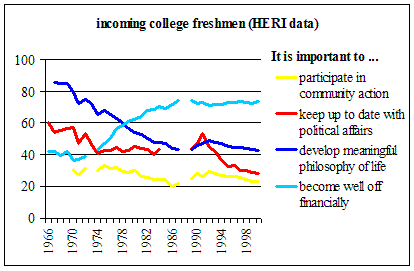
If your job is to educate adolescents in this climate, then you may feel that you must tell them about these opportunities and risks. They cannot rely on peers, communities, or voluntary associations to get ahead. Instead, they must develop marketable skills. A skill or experience that can be recognized formally is better than one that eludes classification.
There is one national or international employment market; many kids would be smart to get out of their own neighborhoods, family networks, and cities in order to compete in that market. College is the first step out. Public Agenda Foundation recently polled a national sample of young adults and conducted some focus groups of the same population. One young Hispanic man reported the message that he had received from his parents, which was fairly typical: "It's basically, you go to college you get to live well. ... They used to tell me and my brothers and sisters, 'Do you want to be succcessful? Do you want to live in a house? ... Go to college.'"
Unfortunately, only about two thirds of adolescents (and half of Latinos and African Americans) complete high school; and only about one third attend college. Colleges are arrayed in a national "pecking order" of prestige. They all demand roughly the same skills and experiences from their applicants. Every kid had better try to get into college, and the "best" college he or she can.
One young adult in the Public Agenda study gave this advice to a younger sibling who is just entering high school: "Know your conselor and tell her, 'This is what I want to do; help me find the best school that I could get into.'" If teachers and counselors fail to teach working class and rural or inner-city kids how to play the game, then those students will have an extra, unfair disadvantage versus the children of yuppies, who understand the rules.
There are advantages to this new system, but it also has some disadvantages. First, teenagers are being asked to make decisions that have excessively serious long-term consequences. While adults should normally pay the price for decisions we make, it's too much to ask unsupported 14-year-olds to make choices that will affect them 30 years later.
Second, schools face two basically unpalatable choices. They can try to motivate all their students to play the game as hard and as well as possible (which is difficult and creates intense pressure), or they can serve as "gatekeepers," deciding which kids may take honors courses, which ones may serve on the school newspaper, which ones may apply to Harvard. Then schools have enormous power.
Third, everything seems to matter only for its impact on adult life. Kids don't learn because subjects are interesting; they don't participate in extracurricular groups because they're fun. Instead, they do what they need for their resumes. In the Public Agenda survey, 49% of young adults said that college is most important because it provides "a credential that employers with good jobs look for"; 26% said that it's important because it "helps make you a responsible adult"; and 23% say it's important because it provides "real skills."
Finally, this kind of pressure is not good for civic learning, because it doesn't reward students for caring about their immediate surroundings--their peers and communities. It doesn't teach cooperation. It doesn't emphasize shared or public problems, because the only goal is to impart individualized "human capital" for the marketplace.
If all this is roughly right, then the question is: Can high schools be redesigned so that they promote collaboration, equity and mixing, concern for community, and civic skills? Will that kind of reform simply leave working class kids at a disadvantage in the race against yuppy children whose parents know how to make sure they obtain "human capital"? Or can small "learning communities," authentic "service opportunities," and "community-based learning," make life better for all adolescents?
In some ways, this is the heart of the debate about high school reform, as reflected in recent public statements by Margaret Spellings, Diane Ravitch, and others. The key question is: Must we ratchet up the pressure on all students (and their teachers) so that everyone gets off to a better start in the marketplace? Or can we make high schools a partial refuge from an intensely competitive world in order to enhance other values?
Posted by peterlevine at 07:33 AM | Comments (0)
April 01, 2005
sticks and stones ...
Civility is important. When public figures attack individuals and their motives rather than ideas and policies, they can make it harder to work together--even on completely unrelated issues. Furthermore, politics as a whole can become unpleasant, in which case some citizens will avoid participating.
Tom DeLay and his friends have certainly not been "civil" in their response to the Schiavo case:
'The time will come for the men responsible for this to answer for their behavior, but not today,' said Mr. DeLay. .. Saying that the courts 'thumbed their nose at Congress and the president,' Mr. DeLay, of Texas, suggested Congress was exploring responses and declined to rule out the possibility of Congressional impeachment of the judges involved. [...] Dr. James C. Dobson, the founder of the evangelical group Focus on the Family, said the judges who would not stop the removal of Ms. Schiavo's feeding tube were 'guilty not only of judicial malfeasance' but of the cold-blooded, cold-hearted extermination of an innocent human life."
I am not going to defend these statements, but I will propose some reasons not to take them overly seriously.
First, although civility is desirable, it is not always possible. Politics is infused with life-and-death issues, and people on all sides of the debate have principled reasons to hold their opponents guilty of killing. DeLay, Dobson, and their allies think that judges killed Terri Schiavo. Many of my friends and colleagues believe that George W. Bush has "cold-bloodedly" and "cold-heartedly" sent American soldiers and Iraqi civilians to their deaths. When the Environmental Protection Agency sets an allowable level of pollution, it recognizes that x people in 1,000 will die as a result. Yet if it were to choose a lower level, possibly jobs would be lost and people would die from the resulting stress, crime, and suicide. Cuts in health spending may cause people to die. Certainly the electric chair kills.
This list is not meant to make light of any of the accusations that people make against judges, President Bush, Congress, or the EPA. Some of the charges are valid, and it's important to decide which are fair and which are not. At the same time, it's inevitable that political antagonists will see their opponents as guilty of homicide. We can't expect them to keep their beliefs secret, yet we must be able to live together in a peaceful polity.
Perhaps we should try to enhance civility by creating appropriate forums for moderated discussions, teaching young people to deliberate about serious issues--and marginalizing the likes of James Dobson. But ultimately, we need stronger measures than good manners and habits of deliberation. For example, federal judges are protected by life tenure. They should recognize that this privilege exists precisely because the elected branches of government are likely to lash out at them from time to time. Their responsibility is to ignore the taunts and keep doing their jobs. If Tom DeLay really tries to impeach them, he is likely to fail humiliatingly in his own House. And if he drops the threat, then the judiciary has won.
Besides, civility involves a tradeoff. On one hand, angry personal accusations can alienate people who want to participate in pleasant, constructive political discussions. On the other hand, passionate accusations can mobilize citizens. Thus, in 2004, when charges of genocide and treason were being flung around on all sides, we saw the highest turnout since 1968 (also a year when rhetoric reached a boiling point). I don't like the current rhetorical temperature, myself, but I don't want to be fastidious or thin-skinned. Although threats may cause violence, I'm not convinced that Tom DeLay's rhetoric has added to anyone's physical endangerment. We shouldn't quickly label rhetoric as dangerous, because then anyone who accused Bush of "murdering" Iraqis would have to be seen a threat to the president.
Posted by peterlevine at 01:10 PM | Comments (0)